From a few weeks ago in early February:
First, some chilly storytelling. Next, a ziggurat built in the sandbox:
March 7, 2013
February 11, 2013
Grief over losing a friend
From Ms E:
"This week we covered the difficult topic of loss and grief. In the story, Gilgamesh loses his best friend, Enkidu. The children were saddened and scared, but were able to talk about how Gilgamesh felt. We discussed the many ways that grief can be expressed, whether through anger, sadness, or loneliness. Although the story was heavy, the children held hope for Gilgamesh, and made predictions about what might happen next.
Turning again to the theme of construction, we built another ziggurat, this time, with oh so heavy bricks! Although these bricks may not be the large mud bricks used in ancient Mesopotamia, these bricks give us an idea of how much work goes into building a giant ziggurat. However, when asked if he liked carrying bricks, E said he could do it all day! The children came up with quite an interesting design, with the inclusion of bridges and cuneiform symbols painted on with charcoal. There was also a discovery of roly polies, which of course had to be given a home in the ziggurat!"
"This week we covered the difficult topic of loss and grief. In the story, Gilgamesh loses his best friend, Enkidu. The children were saddened and scared, but were able to talk about how Gilgamesh felt. We discussed the many ways that grief can be expressed, whether through anger, sadness, or loneliness. Although the story was heavy, the children held hope for Gilgamesh, and made predictions about what might happen next.
Turning again to the theme of construction, we built another ziggurat, this time, with oh so heavy bricks! Although these bricks may not be the large mud bricks used in ancient Mesopotamia, these bricks give us an idea of how much work goes into building a giant ziggurat. However, when asked if he liked carrying bricks, E said he could do it all day! The children came up with quite an interesting design, with the inclusion of bridges and cuneiform symbols painted on with charcoal. There was also a discovery of roly polies, which of course had to be given a home in the ziggurat!"
Posted by
schole
Inscription and Image
R missed this week's Gilgamesh gathering due to a family trip to Kansas City. Yet she still got a taste of Mesopotamia when she encountered an Assyrian palace sculpture at the Nelson-Atkins Museum.Her eyes lit up once she looked more closely and realized that inscribed onto the surface of the statue itself was . . . cuneiform.
Posted by
schole
February 4, 2013
Four ways to end a wrestling match
Here's one version of the initial, violent encounter of Gilgamesh and Enkidu, from Tablet II:
Enkidu blocked the entry to the marital chamber,
and would not allow Gilgamesh to be brought in.
They grappled with each other at the entry to the marital chamber,
in the street they attacked each other, the public square of the land.
The doorposts trembled and the wall shook,
Gilgamesh bent his knees, with his other foot on the ground,
his anger abated and he turned his chest away.
. . . They kissed each other and became friends.
Their first impulse is to grapple with one another, as enemies. But finding one another equal in strength, the wrestling turns to an embrace, as intimates. Later, they take on the bull of heaven, together; wrestling with the natural world is apparently a common motif in Mesopotamian art.
As we think back to the struggles of last year's Greek heroes, one notable difference from Gilgamesh is the comparative solitude of the quests of Telemachus (who wrestles with Proteus) and Odysseus (who earlier in The Iliad defeated Ajax during their funeral games for Patroclus). In the Homeric epics, one man bests another, and carries this triumph forward. For Gilgamesh, wrestling provides an occasion for recognizing an extraordinary peer, one about whom he had been dreaming.
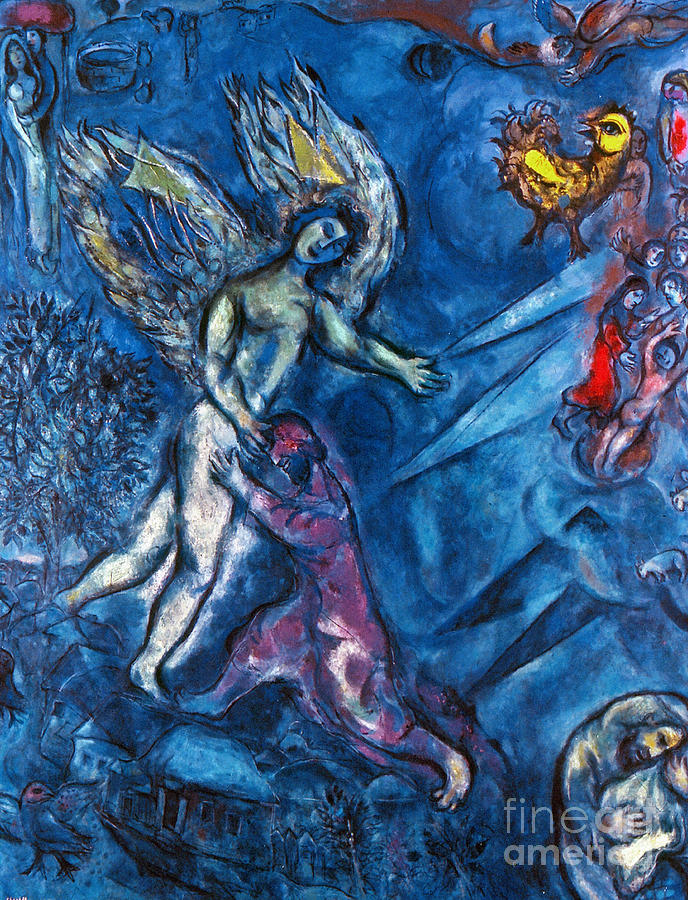
A third, biblical analogue (Genesis 32) is Jacob wrestling with—a man? an angel? God? himself?
| Ludmila Zeman, Gilgamesh the King |
Enkidu blocked the entry to the marital chamber,
and would not allow Gilgamesh to be brought in.
They grappled with each other at the entry to the marital chamber,
in the street they attacked each other, the public square of the land.
The doorposts trembled and the wall shook,
Gilgamesh bent his knees, with his other foot on the ground,
his anger abated and he turned his chest away.
. . . They kissed each other and became friends.
Their first impulse is to grapple with one another, as enemies. But finding one another equal in strength, the wrestling turns to an embrace, as intimates. Later, they take on the bull of heaven, together; wrestling with the natural world is apparently a common motif in Mesopotamian art.
![]() |
| 4th century BCE coin |
As we think back to the struggles of last year's Greek heroes, one notable difference from Gilgamesh is the comparative solitude of the quests of Telemachus (who wrestles with Proteus) and Odysseus (who earlier in The Iliad defeated Ajax during their funeral games for Patroclus). In the Homeric epics, one man bests another, and carries this triumph forward. For Gilgamesh, wrestling provides an occasion for recognizing an extraordinary peer, one about whom he had been dreaming.
![]() |
| Marc Chagall, Jacob Wrestling with the Angel |
A third, biblical analogue (Genesis 32) is Jacob wrestling with—a man? an angel? God? himself?
Jacob was left alone. And a man wrestled with him until the break of dawn. When he saw that he had not prevailed against him, he wrenched
Jacob’s hip at its socket, so that the socket of his hip was strained as
he wrestled with him.
Throughout the history of reading and interpreting writing,
there are places where you don’t even know with what obscure thing you
are wrestling. The outcome is uncertain. And when you begin to delve into
commentary, you are immediately reminded that you are not alone in this
struggle—centuries of careful thinkers have similarly wrestled with the text,
and with one another, in an ongoing conversation.
![]() |
| 2009 Globe As You Like It |
Shakespeare gives us a fourth outcome, with wrestling leading not to glory, or male-bonding, or a confrontation between the self and the divine, but to a metaphor for romance. In As You Like It, Rosalind effuses to an unexpectedly victorious Orlando: "Sir, you have wrestled well, and overthrown / More than your enemies." To himself, he marvels in reply: "O poor Orlando! Thou art overthrown"—by love.
Here are the closing lines from a poem by Rilke, which alludes to the Genesis account above. No matter the outcome, it's clear the these intense physical encounters have left the wrestlers changed, often irrevocably.
“The Man Watching” (translated by Robert Bly)
When we win it's with small things,
and the triumph itself makes us small.
What is extraordinary and eternal
does not want to be bent by us.
I mean the Angel who appeared to the wrestlers of the Old Testament:
when the wrestlers’ sinews
grew long like metal strings,
he felt them under his fingers
like chords of deep music.
Whoever was beaten by this Angel
(who often simply declined the fight)
went away proud and strengthened
and great from that harsh hand,
that, like a sculptor’s, shaped him.
Winning does not tempt that man.
This is how he grows: by being defeated, decisively,
by constantly greater forces.
When we win it's with small things,
and the triumph itself makes us small.
What is extraordinary and eternal
does not want to be bent by us.
I mean the Angel who appeared to the wrestlers of the Old Testament:
when the wrestlers’ sinews
grew long like metal strings,
he felt them under his fingers
like chords of deep music.
Whoever was beaten by this Angel
(who often simply declined the fight)
went away proud and strengthened
and great from that harsh hand,
that, like a sculptor’s, shaped him.
Winning does not tempt that man.
This is how he grows: by being defeated, decisively,
by constantly greater forces.
Posted by
schole
Lecture on Odyssey statues
From Professor Tronchin at Rhodes College:
Please join the Department of Art & Art History in welcoming Professor Steven Tuck (Classics and Art History, Miami University of Ohio).
He will present the annual Ruffin Lecture in the Fine Arts this Thursday, February 7, at 6PM in Frazier Jelke B.
Tuck will be speaking about the grotto of the Roman emperor Tiberius at Sperlonga, south of Rome.
It was a cave turned into an elaborate and unique “banquet hall,” filled with sculptures depicting scenes from the Odyssey, including the blinding of Polyphemus and Scylla attacking Odysseus’ ship. These statues are colossal—think minivan-sized or larger.
As the cave was only discovered and excavated in the 1950s, the sculpture and the related dining space and villa are quite open for interpretation.
Please join the Department of Art & Art History in welcoming Professor Steven Tuck (Classics and Art History, Miami University of Ohio).
He will present the annual Ruffin Lecture in the Fine Arts this Thursday, February 7, at 6PM in Frazier Jelke B.
Tuck will be speaking about the grotto of the Roman emperor Tiberius at Sperlonga, south of Rome.
It was a cave turned into an elaborate and unique “banquet hall,” filled with sculptures depicting scenes from the Odyssey, including the blinding of Polyphemus and Scylla attacking Odysseus’ ship. These statues are colossal—think minivan-sized or larger.
As the cave was only discovered and excavated in the 1950s, the sculpture and the related dining space and villa are quite open for interpretation.
![]() |
| Reconstruction of the Polyphemus group from the Sperlonga grotto |
Posted by
schole
January 25, 2013
Listening to Gilgamesh
E's grandfather has been following our progress online, and he recommends the "History of Our World" podcast on Gilgamesh. It's 45 minutes long, and dramatizes the epic.
A good video introduction to the cultural legacy of Gilgamesh can be found in this program, 30 minutes long. It includes interviews with Ludmila Zeman, David Damrosch, and others who have interpreted and retold this story.
And there is a 15-minute BBC podcast on the 1872 rediscovery of the flood tablet, which made one otherwise staid library assistant understandably ecstatic. This comes from the incomparable "A History of the World in 100 Objects"; hear also the earlier episodes on cuneiform, and on the Standard of Ur.
The kids genuinely love it when family and friends become involved in the story's background. It's marvelous to hear them discussing the narrative with peers as well as adults. Your interest helps reinforce the their own curiosity about this fascinating era and epic.
p.s. the version Miss E has been reading them is called Gilgamesh the Hero, adapted by Geraldine McCaughrean. And everyone has a copy of an informative DK volume on Mesopotamia. We can recommend both -- and there are many more books in our library for lending (see the other column on the right).
Posted by
schole
January 24, 2013
Humbaba -- Tablet 3
From Miss E:
Today marked the third day of following Gilgamesh's epic adventure. First, we briefly recounted last week's class, which led to discussing the length of time that has passed since the reign of Gilgamesh, around 4,000 years ago. This in turn led to quite some interesting questions from the group.... E: How long ago did life on Earth start? H: How was the first person born? J: Maybe two dinosaurs had a human. I think the life started when everything was still, then it all went CRASH together [these aren't their exact words, but it's the general idea].
Then we dove right into Tablet 3. During this part of the story, Gilgamesh, and his new BFF, Enkidu, plot to enter into the forbidden Cedar Forest, ruled by the fearsome Humbaba. This gigantic, horrid monster was traditionally known to have a lion's head and dragon's teeth. Today we painted Humbabas of our own, quite a sight to behold!
After imagining these gruesome monsters coming to life from the paper, as E excitedly did, we settled down to finish painting our beads.
Today marked the third day of following Gilgamesh's epic adventure. First, we briefly recounted last week's class, which led to discussing the length of time that has passed since the reign of Gilgamesh, around 4,000 years ago. This in turn led to quite some interesting questions from the group.... E: How long ago did life on Earth start? H: How was the first person born? J: Maybe two dinosaurs had a human. I think the life started when everything was still, then it all went CRASH together [these aren't their exact words, but it's the general idea].
Then we dove right into Tablet 3. During this part of the story, Gilgamesh, and his new BFF, Enkidu, plot to enter into the forbidden Cedar Forest, ruled by the fearsome Humbaba. This gigantic, horrid monster was traditionally known to have a lion's head and dragon's teeth. Today we painted Humbabas of our own, quite a sight to behold!
After imagining these gruesome monsters coming to life from the paper, as E excitedly did, we settled down to finish painting our beads.
Posted by
schole
January 21, 2013
She formed him out of clay and leaves.
Last Thursday, we added H and J-L to our second Gilgamesh adventure. First, Ms.E reviewed what happened last week. I was excited to hear that everyone excitedly answered "Mesopotamia!" when asked where our story took place.
Ms. E read another section of the text, paying special attention to Wild Man and the hunter. Ururu, the goddess, fashioned Enkydu from clay and leaves and twigs. H said that Enkydu probably looked like a Minotaur. They discussed how Enkydu felt about the hunter's traps and pots. Ms. E read about the woman sent to the forest to tame Enkydu and how every time he went to growl and howl, she would kiss him. The children commented on how she captured him with love rather than traps and snares.
Ms. E read about the first meeting of Enkydu and Gilgamesh - their wrestling match turned to hugs and laughter. They talked about what it must have felt like for Gilgamesh to finally have found a friend.
Ms. E lead the children outside to collect their own materials for creating Enkydu. They found sticks, straw, charcoal, sand, dirt, chicken feathers, leaves and berries. Invoking Ururu, they mixed their materials together with clay and formed their own wild men. E put a stone inside his head. R labored on a head. J-L fastidiously created a well dressed warrior.
Next, they revisited the beads from last week and painted them. H made some new beads and J was inspired to create a clay pendant styled after the filigree gold jewelry found from ancient Mesopotamia.
Another great adventure complete, the kids checked out books to tide them over until next week.
Posted by Sarah
Ms. E read another section of the text, paying special attention to Wild Man and the hunter. Ururu, the goddess, fashioned Enkydu from clay and leaves and twigs. H said that Enkydu probably looked like a Minotaur. They discussed how Enkydu felt about the hunter's traps and pots. Ms. E read about the woman sent to the forest to tame Enkydu and how every time he went to growl and howl, she would kiss him. The children commented on how she captured him with love rather than traps and snares.
Ms. E read about the first meeting of Enkydu and Gilgamesh - their wrestling match turned to hugs and laughter. They talked about what it must have felt like for Gilgamesh to finally have found a friend.
Ms. E lead the children outside to collect their own materials for creating Enkydu. They found sticks, straw, charcoal, sand, dirt, chicken feathers, leaves and berries. Invoking Ururu, they mixed their materials together with clay and formed their own wild men. E put a stone inside his head. R labored on a head. J-L fastidiously created a well dressed warrior.
Next, they revisited the beads from last week and painted them. H made some new beads and J was inspired to create a clay pendant styled after the filigree gold jewelry found from ancient Mesopotamia.
Another great adventure complete, the kids checked out books to tide them over until next week.
Posted by Sarah
Posted by
Sarah N
January 20, 2013
The Epic of Gilgamesh Begins
Last Thursday we began our newest epic adventure - Gilgamesh. Like our Odyssey odyssey, Ms. E will lead our children to explore the story of love, friendship, trust, heartbreak and overcoming challenges. H was ill, so the journey kicked off with J, E and R.
Ms. E began the session with a geography lesson on ancient Mesopotamia and located the Fertile Crescent on the globe, map and google Earth. The children looked at the timeline to put this ancient story into perspective. Ms. E read the beginning of the story and the children talked about tyranny and what it means to be a good leader vs a bad leader. They talked about what it meant for Gilgamesh to be completely friendless.
Ms. E showed them cuneiform writing. The children made their own clay tablets and took a stab at writing in code. J was very interested in writing her name using a cuneiform version of letters. R created a symbol that would represent her name. E created a sentence using cuneiform symbols for water and reeds.
After the tablets were set to dry, Ms. E showed the children pictures of jewelry from ancient Mesopotamia. The crew made beads of all shapes and sizes.
It was a great start to exploring the Epic!
Ms. E began the session with a geography lesson on ancient Mesopotamia and located the Fertile Crescent on the globe, map and google Earth. The children looked at the timeline to put this ancient story into perspective. Ms. E read the beginning of the story and the children talked about tyranny and what it means to be a good leader vs a bad leader. They talked about what it meant for Gilgamesh to be completely friendless.
Ms. E showed them cuneiform writing. The children made their own clay tablets and took a stab at writing in code. J was very interested in writing her name using a cuneiform version of letters. R created a symbol that would represent her name. E created a sentence using cuneiform symbols for water and reeds.
After the tablets were set to dry, Ms. E showed the children pictures of jewelry from ancient Mesopotamia. The crew made beads of all shapes and sizes.
It was a great start to exploring the Epic!
Posted by
Sarah N
Subscribe to:
Posts (Atom)