October 12, 2021

"Listen to this, now . . . . [Homer] was meant to be listened to."


[From the Writer's Almanac for Tuesday, October 12]


It's the birthday of the poet and translator Robert Fitzgerald (books by this author), born in Geneva, New York (1910), best known for his beautiful English translations of Homer's Odyssey (1961) and The Iliad (1974). He was also an influential classics professor at Harvard and he believed that Homer's work should be always read aloud. One of his students said, "Every Tuesday afternoon, he'd start [class] by saying to us, 'Listen to this, now [...] It was meant to be listened to.' The 12 of us would listen, very quiet around the blond wood table, our jittery freshman muscles gradually unclenching."

Robert Fitzgerald described Homer as:

"[A] living voice in firelight or in the open air, a living presence bringing into life his great company of imagined persons, a master performer at his ease, touching the strings, disposing of many voices, many tones and tempos, tragedy, comedy, and glory, holding his [listeners] in the palm of his hand."

October 10, 2021

"Always start with Homer's 'Odyssey'" — Mary Beard


Mary Beard recommends Homer:

https://www.nytimes.com/2021/10/07/books/review/mary-beard-by-the-book-interview.html

What books got you interested in Ancient Rome and the classics?

 The first was Moses Finley’s “The World of Odysseus.” I had read quite a bit of Homer’s “Odyssey” at high school (some in Greek, but mostly in English!); but it was Finley’s book that made me see that you could think about the “Odyssey” historically and that there were big historical questions about what kind of society was being depicted, and whether it ever existed. . . . 

For readers new to the classics, what books make the best entree to the great works of antiquity?

Always start with Homer’s “Odyssey.” It is such a foundational text for so much of the rest of the Western cultural tradition, while at the same time questioning that tradition before it was born. It raises big issues about what we think “civilization” is, the long history of turning our enemies into “barbarians” and why it might be “us” who are the barbarians, not “them.” No wonder it has been so important for writers and artists such as Derek Walcott and Romare Bearden.


October 25, 2019

Ravana’s Mechanical Flying Peacock


In this essay, Justin Henry, a 2017-18 CAORC NEH Senior Research Fellow, discusses the origins and implications of Ravana's flying machine, a popular figure in Sri Lankan versions of the Ramayana epic. All photos are courtesy of the author.

https://www.caorc.org/post/2019/06/10/ravanas-mechanical-flying-peacock

“Ravana was a great king of Sri Lanka 8000 years ago,” he went on earnestly. “And, you know, he had an airplane powered by a mercury vortex engine. We had such technology in those days.”
This was not the last that I would hear of Ravana’s flying machine and its “mercury vortex” propulsion . . .


October 10, 2019

"finding human voices in the clay"

A review of a new book on "Gilgamesh," by Michael Schmidt:

https://www.newyorker.com/magazine/2019/10/14/how-to-read-gilgamesh

How to Read “Gilgamesh”

The heart of the world’s oldest long poem is found in its gaps and mysteries.

November 5, 2017

New translator of “The Odyssey”

https://www.nytimes.com/2017/11/02/magazine/the-first-woman-to-translate-the-odyssey-into-english.html

Since the “Odyssey” first appeared in English, around 1615, in George Chapman’s translation, the story of the Greek warrior-king Odysseus’s ill-fated 10-year attempt to return home from the war in Troy to Ithaca and his wife, Penelope, has prompted some 60 English translations, at an accelerating pace, half of them in the last 100 years and a dozen in the last two decades. Wilson, whose own translation appears this week, has produced the first English rendering of the poem by a woman.

June 5, 2017

Bob Dylan on Odysseus

from Dylan's Nobel Prize speech:

http://www.nobelprize.org/nobel_prizes/literature/laureates/2016/dylan-lecture.html

The Odyssey is a great book whose themes have worked its way into the ballads of a lot of songwriters: "Homeward Bound, "Green, Green Grass of Home," "Home on the Range," and my songs as well.
The Odyssey is a strange, adventurous tale of a grown man trying to get home after fighting in a war. He's on that long journey home, and it's filled with traps and pitfalls. He's cursed to wander. He's always getting carried out to sea, always having close calls. Huge chunks of boulders rock his boat. He angers people he shouldn't. There's troublemakers in his crew. Treachery. His men are turned into pigs and then are turned back into younger, more handsome men. He's always trying to rescue somebody. He's a travelin' man, but he's making a lot of stops.
He's stranded on a desert island. He finds deserted caves, and he hides in them. He meets giants that say, "I'll eat you last." And he escapes from giants. He's trying to get back home, but he's tossed and turned by the winds. Restless winds, chilly winds, unfriendly winds. He travels far, and then he gets blown back.
He's always being warned of things to come. Touching things he's told not to. There's two roads to take, and they're both bad. Both hazardous. On one you could drown and on the other you could starve. He goes into the narrow straits with foaming whirlpools that swallow him. Meets six-headed monsters with sharp fangs. Thunderbolts strike at him. Overhanging branches that he makes a leap to reach for to save himself from a raging river. Goddesses and gods protect him, but some others want to kill him. He changes identities. He's exhausted. He falls asleep, and he's woken up by the sound of laughter. He tells his story to strangers. He's been gone twenty years. He was carried off somewhere and left there. Drugs have been dropped into his wine. It's been a hard road to travel. 
In a lot of ways, some of these same things have happened to you. You too have had drugs dropped into your wine. You too have shared a bed with the wrong woman. You too have been spellbound by magical voices, sweet voices with strange melodies. You too have come so far and have been so far blown back. And you've had close calls as well. You have angered people you should not have. And you too have rambled this country all around. And you've also felt that ill wind, the one that blows you no good. And that's still not all of it. 
When he gets back home, things aren't any better. Scoundrels have moved in and are taking advantage of his wife's hospitality. And there's too many of ‘em. And though he's greater than them all and the best at everything – best carpenter, best hunter, best expert on animals, best seaman – his courage won't save him, but his trickery will.
All these stragglers will have to pay for desecrating his palace. He'll disguise himself as a filthy beggar, and a lowly servant kicks him down the steps with arrogance and stupidity. The servant's arrogance revolts him, but he controls his anger. He's one against a hundred, but they'll all fall, even the strongest. He was nobody. And when it's all said and done, when he's home at last, he sits with his wife, and he tells her the stories.
. . . When Odysseus in The Odyssey visits the famed warrior Achilles in the underworld – Achilles, who traded a long life full of peace and contentment for a short one full of honor and glory –  tells Odysseus it was all a mistake. "I just died, that's all." There was no honor. No immortality. And that if he could, he would choose to go back and be a lowly slave to a tenant farmer on Earth rather than be what he is – a king in the land of the dead – that whatever his struggles of life were, they were preferable to being here in this dead place. 
That's what songs are too. Our songs are alive in the land of the living. But songs are unlike literature. They're meant to be sung, not read. The words in Shakespeare's plays were meant to be acted on the stage. Just as lyrics in songs are meant to be sung, not read on a page. And I hope some of you get the chance to listen to these lyrics the way they were intended to be heard: in concert or on record or however people are listening to songs these days. I return once again to Homer, who says, "Sing in me, oh Muse, and through me tell the story."

May 24, 2017

"Some Other Odysseus"

From the fun website "Sententiae Antiquae":

https://sententiaeantiquae.com/some-other-odysseus/


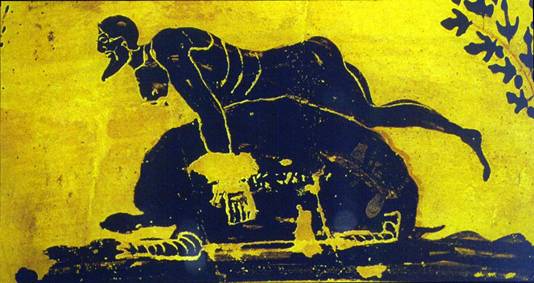
https://sententiaeantiquae.files.wordpress.com/2014/10/odysseus-riding-turtle.jpg
Odysseus Rides a turtle (6th Century BCE Black Figure Skyphos)

When Odysseus reveals himself to Telemachus in book 16, his son at first balks, certain that this man in front of him is a god or some delusion.  Odysseus responds memorably (16.204):

“No other Odysseus will ever come home to you”
οὐ μὲν γάρ τοι ἔτ’ ἄλλος ἐλεύσεται ἐνθάδ’ ᾿Οδυσσεύς,

I have long discussed this with my students as doing double work in the Odyssey:  (1)it speaks to concerns of identity and sameness and the difficulty of knowing who anyone is at any time; and (2) it also allows our narrator to ‘wink’ at the audience who have been treated to a bit of a carnival ride during the epic as they figure out which Odysseus this is who is going to come home.
Ancient myth and literature present us with many different Odysseis (the plural of Odysseus) and one of the great achievements of our Odyssey may just be the creation of a complex hero within and against these parameters.  Close readings of the epic can find that there are hints of these other traditions, these other Odysseys and Odysseis everywhere.

So, occasionally we will be posting on this theme:

1. First we discussed how Aeschylus had Odysseus dying from complications associated with being defecated upon by a bird.
2. Then we noticed that the epic mentions that Odysseus has a sister
3. We also considered how Telemachus’ bath in book 4 led to a grandson for Odysseus in the Hesiodic tradition.
4. Here’s a rumination on the politics and geography in the Odyssey
5. And a beginning count of Odysseus’ children
6. The Evidence for Odysseus’ Children, Part 1: Eustathius, Hesiod and Dionysus of Halicarnassos
7. Odysseus’ Children with Penelope (yes, more than one!)
8. An Epigram from the Greek Anthology about Odysseus seeing his mother, Antikleia
9. Odysseus’ Children, Part 3: The Sons of Kirke, (except Telegonos)
10. The Sons of Odysseus, Part 4: Telegonos
11. The Sons of Odysseus, Part 5: Kalypso’s Brood
12. Odysseus Tries to Stab Diomedes in the Back
13. Odysseus’ Children Part 6

April 17, 2017

A Father and Son's Final Odyssey

In the last year of my dad’s life, we retraced Odysseus’ voyage and learned what Homer teaches about life’s journeys and what it means to yearn for home.

http://www.newyorker.com/magazine/2017/04/24/a-father-and-sons-final-odyssey


October 10, 2016

"the oldest melody in existence"

http://www.classicfm.com/music-news/videos/oldest-song-melody/

The lyrics are very difficult to translate, but one academic has come up with this rendering of them:

‘Once I have endeared the deity, she will love me in her heart,
the offer I bring may wholly cover my sin, 
bringing sesame oil may work on my behalf in awe may I'

Gilgamesh and tyranny


Danielle Allen in the Washington Post:

The world’s oldest surviving text is about how to deal with a problem like Donald Trump. In the “Epic Gilgamesh,” which dates to 2100 B.C., the people of the city of Uruk in Mesopotamia lift their voices to the gods in complaint about their king, Gilgamesh. In David Ferry’s marvelous translation, the people of Uruk lament: “Neither the father’s son nor the wife of the noble is safe in Uruk; neither the mother’s daughter nor the warrior’s bride is safe.”

The people first try to protect themselves by seeking a double for Gilgamesh, someone who is in some important sense like him, who can contend with him and who can keep him in check. . . . In the epic, the double’s name is Enkidu, and it is Enkidu who finally blocks Gilgamesh from entering a bridal chamber ahead of the bridegroom. . . . In the epic “Gilgamesh,” the tyrant becomes a good king only when he comes to recognize that in his own mortality he is no greater than the lowliest peasant. Reflecting on death, he says, “And then I saw a worm fall out of his nose. Must I die too?” Assimilating this lesson, Gilgamesh is at last able to rein in his passions, develop virtues and become a beneficent king.

Scientists Trace Society’s Myths to Primordial Origins

Julien d'Huy in Scientific American:

The first version of the Cosmic Hunt, the ancestor of all the other accounts of the story of Callisto, reconstructed from three different databases, would have gone like this: A man is hunting an ungulate; the hunt takes place in the sky or ends there; the animal is alive when it is transformed into a constellation; and this constellation is the one we know as Ursa Major.

October 1, 2015

Gilgamesh-ish?

A newly discovered Gilgamesh tablet, with Humbaba -- and monkeys?


June 16, 2015

James Joyce Explains Why Ulysses Is the Most “Complete Man” inLiterature

"Hamlet is a human being, but he is a son only. Ulysses is son to Laertes, but he is father to Telemachus, husband to Penelope, lover of Calypso, companion in arms of the Greek warriors around Troy and King of Ithaca. He was subjected to many trials, but with wisdom and courage came through them all. Don’t forget that he was a war dodger who tried to evade military service by simulating madness. He might never have taken up arms and gone to Troy, but the Greek recruiting sergeant was too clever for him and, while he was ploughing the sands, placed young Telemachus in front of his plough. But once at the war the conscientious objector became a jusqu’auboutist. When the others wanted to abandon the siege he insisted on staying till Troy should fall."
A jusqu’auboutist is one who sticks it out to the end.

"Nausicaa," from Henri Matisse's illustrations to the 1935 edition of Joyce's "Ulysses." 

May 3, 2015

"Chekhov for Children"


This documentary recalls our kids' projects of creating and performing serious work based on complex stories: filmmaker Sasha Waters-Freyer "tells the inspiring story of an ambitious undertaking – the 1979 staging on Broadway of Uncle Vanya by New York City 5th & 6th graders, directed by the celebrated writer Phillip Lopate. Using a wealth of never-before-screened student documentary videos and dramatic super 8mm films from the era, Chekhov for Children explores the interplay between art and life for a dozen friends across 30 years."

Lopate wrote an essay on his work with this production.

View at Fandor or email swfreyer@vcu.edu to order a DVD

December 27, 2014

Why Homer Matters (review)


https://www.nytimes.com/2014/12/28/books/review/why-homer-matters-by-adam-nicolson.html?_r=0

“Homer has become a kind of scripture for me, an ancient book, full of urgent imperatives and ancient meanings, most of them half discerned, to be puzzled over. It is a source of wisdom.” So begins the third chapter of Adam Nicolson’s highly accessible new book, “Why Homer Matters,” in which he compares his relationship with epic poetry to a form of possession, a “colonization of the mind by an imaginative presence from the past.” The world needs more Adam Nicolsons, unabashedly passionate evangelists for the power of ancient poetry to connect us with our collective past, illuminate our personal struggles and interrogate our understanding of human history.
For centuries, the study of Greek literature has been seen as the province of career academics. But Nicolson’s amateurism (in the best, etymological, sense of the word: from the Latin amare, “to love”) and globe-trotting passion for his subject is contagious, intimating that it is impossible to comprehend Homer’s poems from an armchair or behind a desk. If you’ve never read the “Iliad” or the “Odyssey,” or your copies have been collecting dust since college, Nicolson’s book is likely to inspire you to visit or revisit their pages.
According to Nicolson, a British baron who has written books on subjects that span the making of the King James Bible, the challenges and joys of farming, nautical voyages, and long walks through France, “you don’t acquire Homer; Homer acquires you.” Nicolson describes how he set out on a personal odyssey from the coast of Scotland to the gates of Hades in search of the origins of Greek poetry and Western consciousness. In all of this, he is most at home as a writer when describing landscapes, as in his depiction of Homeric Hades by way of the estuary at Huelva in southwestern Spain: “Flakes of white quartzite shine through the water between ribs of rock that veer from red to tangerine to ocher and rust to flame-colored, flesh-colored, sick and livid.”
As Nicolson relates, Homer, the blind bard of Chios who supposedly composed the “Iliad” and the “Odyssey,” may never have existed. Or, if he did, he most likely wasn’t the sole author of the epic poems for which he became famous. Instead, he may have culled, arranged and interpolated these foundational myths from within a living, oral tradition reaching back — through the Greek Dark Ages — to a primitive, preliterate era of Bronze Age wars and warriors sprawled across the Eurasian plains. “The poems,” Nicolson writes, “were composed by a man standing at the top of a human pyramid. He could not have stood there without the pyramid beneath him, and the pyramid consisted not only of the earlier poets in the tradition but of their audiences too.”
This is the central idea behind Nicolson’s book, which traces the origins of the story of the Trojan War and its aftermath — by way of the Minoan ruins of Knossos, the great library of Alexandria, and the National Archaeological Museum in Athens — to a period 1,000 or more years earlier than the one suggested by what he defines as the reigning orthodoxy. Nicolson contends that the epic poems reflect “the violence and sense of strangeness of about 1800 B.C. recollected in the tranquillity of about 1300 B.C.,” though not captured in writing until roughly 700 B.C. And so he believes that whoever wrote the poems down belonged to “a culture emerging from a dark age, looking to a future but also looking back to a past, filled with nostalgia for the years of integrity, simplicity, nobility and straightforwardness.” 
It is difficult to assess Nicolson’s theory, which is based on a conjecture that the “Iliad” describes a pre-palatial warrior culture that seems to align well with the “world of the gold-encrusted kings buried in the shaft graves at Mycenae,” now dated to the 17th and 16th centuries B.C. But as a thought exercise, it is often gripping and, at times, electrifying. 
According to Nicolson, “Epic, which was invented after memory and before history, occupies a third space in the human desire to connect the present to the past: It is the attempt to extend the qualities of memory over the reach of time.” The purpose of epic “is to make the distant past as immediate to us as our own lives, to make the great stories of long ago beautiful and painful now.” 
The Romanian scholar of comparative religion Mircea Eliade called this basic human impulse — to connect our quotidian existence, through ritual and myth, with the lives and struggles of the great heroes of the past — the “eternal return.” In the telling and retelling of the “Iliad” and the “Odyssey,” we imbue our insignificant lives with meaning, transporting ourselves to a mythical time, while bringing the heroic age into our own. Throughout the book, Nicolson describes moments when his own life has been elevated or illuminated by the epics — such as his sailing across the Celtic Sea with the “Odyssey” fastened to his compass binnacle, tied open to the story of the sirens — but also moments when harrowing experiences, including being raped at knife point in the Syrian desert, have revealed to him something powerful within the poems.
The Homeric epics are long, contradictory, repetitive, composite works, riddled with anachronisms, archaic vocabulary, metric filler and exceedingly graphic brutality. Over the millenniums, Nicolson asserts, they have been cleaned, scrubbed and sanitized by generations of translators, editors, librarians and scholars, in order to protect readers from the dangers of the atavistic world lurking just below the surface of the words. He writes that everyone from the editors at the Ptolemaic library in Alexandria to the great 18th-century poet Alexander Pope wished to civilize or tame the poems, “wanted to make Homer proper, to pasteurize him and transform him into something acceptable for a well-governed city.” Part of Nicolson’s objective is to follow the poems back to the vengeful, frighteningly violent time and culture from which they came, and to restore some of their rawness.
For Nicolson, the commonly held belief that the “Iliad” and the “Odyssey” were products of the late eighth century B.C., a period of Greek resurgence and prosperity, cannot account for the heterogeneity of the poems and all they contain. He prefers the view that, instead of being the creation of a single man, let alone of a single time, “Homer reeks of long use.” Try thinking of Homer as a “plural noun,” he suggests, made up of “the frozen and preserved words of an entire culture.” Seen through this lens, the ancient poems appear as a bridge between the present and an otherwise inaccessible past, a rare window into a moment of cultural convergence around 2000 B.C., when East met West, North met South, and Greek consciousness was forged in the crucible of conflict between a savage warrior culture from the flat grasslands of Eurasia and the wealthy, sophisticated residents of cities in the eastern Mediterranean. 
“Homer,” Nicolson writes, “in a miracle of transmission from one end of human civilization to the other, continues to be as alive as anything that has ever lived.” Reading “Why Homer Matters” makes one yearn for a time, almost lost to us now, when many others shared Nicolson’s enthusiasm. 

WHY HOMER MATTERS
by Adam Nicolson
Illustrated. 297 pp. A John Macrae Book/Henry Holt & Company. $30.


December 12, 2014

My inspiration: Sarwat Chadda on Indian hero, Rama

Rama, hero of the Hindu epic the Ramayana, showed the author of the Ash Mistry trilogy what true heroism is: swords and magic armour aside, it means self-sacrifice, humility and defending the weak


Monday 8 December 2014 03.40 EST

I grew up reading the Greek myths. I loved Jason and the Argonauts, Theseus (many a rainy day spent drawing his epic battle versus the Minotaur) and the heroes of the Iliad. Time went on and I became a fan of the Norse Gods. Odin, Loki, Sif and the whole golden, brooding crew. Oh to have a pair of pet ravens!

It wasn’t until I was in my 20s that I really discovered Indian mythology. I travelled around the subcontinent and the Far East as visited places as awe-inspiring as anything out of a fantasy book. The palaces of Angkor Wat. The labyrinthine streets of Varanasi. The monasteries of Tibet. Why live in Middle Earth when you had places like this, for real?

The idea of writing a series sent in the East took almost 20 years to come to the page. The Ash Mistry trilogy takes a modern, British kid and hurls him neck deep into the war between the gods and monsters of Indian myth. I want to give the reader a taste of the magic of the Eastern world, take them on adventures beyond the now-familiar tropes of Western fantasy. The first book, Ash Mistry and the Savage Fortress is set in the holy city of Varanasi. The next in Kolkata and the last in Tibet and China. It’s about reincarnation, about destiny, and about making the ultimate sacrifice. It’s about becoming a hero. But I wanted my hero, Ash, to be based not on Thor or Achilles, but on an Indian hero. And the biggest of them all is Rama.

What Rama showed me is the universal nature of true heroism. Simply put, swords and magic armour aside, it means self-sacrifice. To put all others, loved ones and strangers, before yourself. To defend the weak. To be humble and generous in victory. Things that might be called “old-fashioned”, but I prefer to call them “classic”.

Rama is the hero of the Indian epic, the Ramayana. Reduced to its bare bones it’s the story of how a prince gives up his claim to his father’s throne, lives as a peasant in the forests with wife and younger brother, and how he battles against a demon king to reclaim his wife when she is kidnapped. The demon king, Ravana, is one of the greatest villains in literature.

Honourable in his own way, it is his pride that is his downfall. He will not bow to a mere man. Even a man like Rama.

Rama doesn’t want war. He is not a glory-seeker like Achilles, nor a boastful blow-hard like Thor. He is quiet, thoughtful, and devastating. Both a man of peace and god of war.


I think this duality is why, perhaps, Indian mythology is harder to access than more familiar and partisan myths of good guys and bad guys. But that’s what makes it so special and Rama one of the most human heroes of all.

September 9, 2014

Hear The Epic of Gilgamesh Read in the Original Akkadian!

From openculture:
gilgamesh sound
Long ago, in the ancient civilization of Mesopotamia, Akkadian was the dominant language. And, for centuries, it remained the lingua franca in the Ancient Near East. But then it was gradually squeezed out by Aramaic, and it faded into oblivion once Alexander the Great Hellenized (Greekified) the region.
Now, 2,000+ years later, Akkadian is making a small comeback. At Cambridge University, Dr. Martin Worthington, an expert in Babylonian and Assyrian grammar, has started recording readings of poems, myths and other texts in Akkadian, including The Epic of Gilgamesh. This clip gives you a taste of what Gilgamesh, one of the earliest known works of literature, sounds like in its mother tongue. Or, you can jump into the full collection of readings right here.

September 4, 2014

30 minute guitar Odyssey

September 30, 2014
7:00pm
Amphitheater, Rhodes College

"a 30 minute long composition for solo acoustic guitar and voice, which tells the story of The Odyssey in song, invoking the spirit of the ancient Greek bards who originally brought forth the timeless stories of Odysseus and the heroes of the Trojan War."


August 24, 2014

Day 24, Book 24

Odysseus reunited with Laertes,
photo of Roman sarcophagus
(Roger Ulrich)
The ghosts of Achilles and Agamemnon – both figures who have loomed large over Odysseus' martial and marital quests – unite in marveling at "Happy Odysseus!" (210) as they receive the shades of the slaughtered suitors in Hades. 

Then, another reunion (with Laertes, Odysseus' father), but not before another test through tale-telling, and another sign of "Living proof" – both his scar (that disclosed him the Eurycleia) and his trees (the vineyard here recalling the rooted bed of Book 23). 

At long last, Athena commands peace, restoring order to Ithaca and drawing closure to the epic.

Day 23, Book 23

"Tree Dream," Joan Harmon (2003)
Penelope tests Odysseus by telling Eurycleia to "move the sturdy bedstead out of our bridal chamber" – impossible, since (as the infuriated Odysseus retorts)

Not a man on earth, not even at peak strength,
would find it easy to prise it up and shift it, no,
a great sign, a hallmark lies in its construction.
I know it, I built it myself – no one else . . .
There was a branching olive-tree inside our court,
grown to its full prime, the bore like a column, thickset.
Around it I built my bedroom, finished off the walls
with good tight stonework, roofed it over soundly
and added doors, hung well and snugly wedged.
Then I lopped the leafy crown of the olive,
clean-cutting the stump bare from roots up,
planing it round with a bronze smoothing-adze –
I had the skill – I shaped it plumb to the line to make
my bedpost, bored the holes it needed with an auger.
Working from there I built my bed, start to finish,
I gave it ivory inlays, gold and silver fittings,
wove the straps across it, oxhide gleaming red.
There's our secret sign, I tell you, our life story! (210–28)

Their mutual recognition confirmed through their intimately crafted space.